

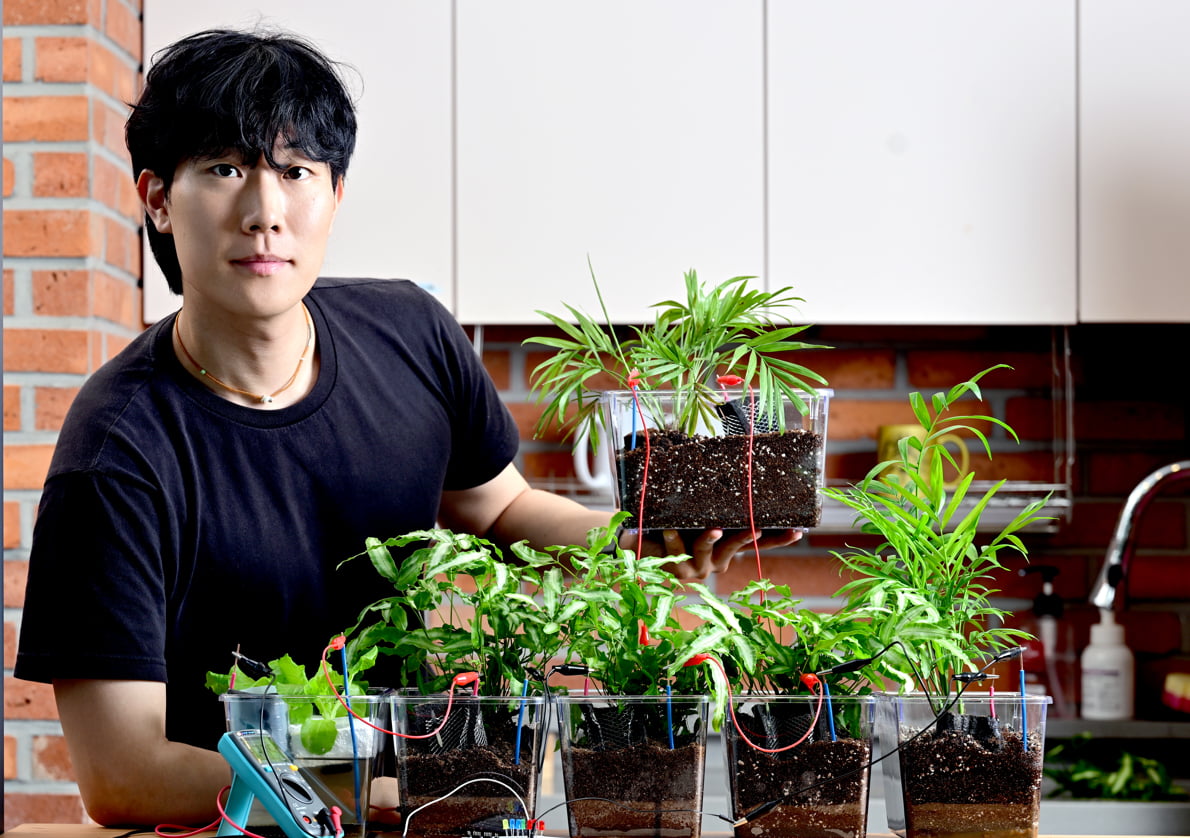
Pisphere is a startup developing a novel eco-friendly energy solution that generates electricity from plants and soil microbes, based on Plant-Microbial Fuel Cell (Plant-MFC) technology. The company began with educational kits and is now developing expanded models, such as power systems for public green spaces. It was founded by CEO Kang Byeong Ju (27).
The company’s flagship technology is Plant-MFC. As plants photosynthesize, up to 40% of their organic matter is released into the soil. Microorganisms in the root zone break down organic matter excreted by plants, releasing electrons. Plant-MFC technology simply collects these free electrons using a specialized electrode to generate a continuous electrical current.
“Right now, we’re producing science kits that use this technology to introduce students to new forms of renewable energy,” says Kang. “It’s an integrated, STEAM-aligned educational tool. Students learn about life sciences through photosynthesis, electrical science by understanding power generation, and energy science by exploring a novel renewable source.”
Building on its initial product, Pisphere plans to expand in two directions: by collecting data and advancing the technology, it will develop a public power infrastructure solution capable of operating low-power facilities like streetlights and Wi-Fi in public green spaces.
The primary competitive edge of plant-MFC technology is its sustainability. Unlike solar or wind, it doesn’t rely on weather and so avoids intermittency issues. Plant-MFCs can be installed anywhere plants grow and provide steady, consistent electricity generation.
The second is space efficiency. Because the technology is fundamentally buried in the soil, it occupies almost no above-ground space. This means solar panels can be installed directly above Pisphere devices. Its high spatial efficiency also makes it ideal for activating idle green spaces. And because the product is made from carbon materials and buried, the risk of soil contamination is less than 1%.
The third strength is its educational and social value. Children can learn about renewable energy by conducting hands-on experiments, and at the same time, the technology can supply clean electricity to community green spaces. It can also light up the night in low-power areas, improving people’s quality of life.
Kang has run hands-on lessons using the educational kit in middle school science classes.
“Based on this experience, I plan to develop sales channels with educational offices. We also see daycare centers as potential customers and are reaching out to them. Right now, we are modeling the product and creating brochures to apply for registration with educational offices and the Public Procurement Service. We are also developing collaborative kits to partner with other educational kit providers.”
What was the inspiration for the company? “The idea was sparked during my master’s studies in Plant Factory Science at Seoul National University,” Kang recalls. “A sudden power outage forced us to discard all the crops we were cultivating. It was a pivotal moment that led me to ask, ‘What if the crops themselves could generate electricity?’ Afterward, I discovered that research on plant-microbial fuel cells (Plant-MFCs) was actively underway in the Netherlands. I became convinced that this technology could truly be the solution to the problem I had been grappling with. I also saw the potential for our country, where 70% of the land is mountainous, to become a giant power plant. So,I started Pisphere to introduce this technology to Korea and the rest of Asia and champion a new form of renewable energy.”
After founding the company, “I feel an immense sense of reward when people react positively to our vision and genuinely cheer us on,” Kang says.
“There’s always a worry about whether the idea will succeed, but when I conduct experiments and see the power output gradually improve, my heart starts to race again.”
The Pisphere team includes a CTO specializing in hardware and a Strategic Planning Manager overseeing business strategy.
Regarding future plans, “In the short term, we will secure a stable revenue base by expanding in the educational market and launching demonstration projects with local governments,” Kang stated. “In the mid- to long-term, our goal is to evolve from an educational product company into a global energy solutions provider. We will expand to build low-power infrastructure in Southeast Asia and Africa, providing clean energy to communities where a lack of even one watt of electricity hinders daily life.”
Date of Establishment: October 2025
Core Business: Next-generation, eco-friendly power generation technology utilizing plant-microbe interactions.
Key Achievements: Silver prize at the 2024 Seoul National University Food-Tech Commercialization Program Selected for the 2025 Startup-Focused University Project (hosted by the Ministry of SMEs and Startups) Finalist at the 2025 NH Ag-Tech Youth Startup Campus Demoday Selected for the 2025 Lab-specialized Leading Startup University Project (hosted by the Ministry of Science and ICT)
reporter jinho lee
jinho2323@hankyung.com
관련뉴스